Marital Regimes in South Africa
Introduction
There are two main marital regimes in South African, all of which play a pivotal role in defining the legal framework that governs the ownership of assets and liabilities within a marriage. South Africa has a diverse cultural landscape and evolving legal system thus understanding these regimes is essential for couples entering into matrimony. The primary regimes are in community of property and out of community of property (with and without the accrual system), each of which distinguish implications for property rights, financial responsibilities, and the division of assets upon divorce or death.
Married in community of property (and profit and loss)
Married in community of property is the marital regime where both spouses share equal and joint ownership of all assets and liabilities acquired before and during the marriage. Both spouses have equal rights and responsibilities regarding the joint property and in the event of divorce or death, the joint estate is divided equally. Additionally, both spouses are jointly liable for any debts incurred during the marriage, which means that one spouse’s financial decisions can impact the other.
Under this regime, all assets and liabilities of both spouses become part of a joint estate.
Advantages
1. Simplicity: it offers a simple approach that all the assets and liabilities are shared equally between the spouses.
2. Equality: there is a concept of fairness in that both spouses have an equal share in the joint estate.
3. Costs: there are no additional legal fees for drafting an Antenuptial Contract.
Disadvantages
1. Restricted independence: consent from both spouses is required for financial transactions.
2. Joint liability: one spouse is responsible for the other’s debt, whether incurred without their consent or knowledge, or not.
Married out of community of property
Being married out of community of property means that the parties entering into an antenuptial contract have chosen to retain their separate property resulting in their complete freedom to deal with that property as they choose. This regime provides couples with greater flexibility by allowing them to choose between two options which are with or without the application of the accrual system.
Spouses who decide to get married out of community of property are required to sign an Antenuptial Contract (ANC), which is also referred to as a Prenuptial Agreement, is a written, legally binding agreement which both spouses sign prior to the union. This agreement must be signed in the presence of a notary public and two witnesses and thereafter, registered in the Deeds Office within three months of its signing. An ANC provides asset protection and allows both spouses to agree on financial arrangements before disputes occur. An advantage of an ANC is that is customised to reflect individual financial situations and personal preferences. For example, if during the marriage, one spouse is declared insolvent, the other’s property is protected from the insolvent spouse’s creditors.
Should you choose to be married out of community of property, you will have to decide whether the accrual system should be applied or not. Under both options of married out of community of property (with or without the accrual system), one spouse's creditors cannot hold the other spouse responsible for debt repayment, in direct contrast to the case where the parties are married in community of property.
With the accrual system
The accrual system is applicable to all marriages out of community of property, unless specifically excluded by the prospective spouses in their antenuptial contract. This option allows spouses to maintain separate estates whilst sharing in the increase of their assets acquired during the marriage.
‘Accrual’ means growth or increase and includes a form of sharing of the assets which are built up during the marriage. The term refers to the net increase in value of a spouse’s estate since the date of marriage to dissolution. In other words, what was yours before the marriage remains yours, and what you have earned during the marriage belongs to both of you. Because the right to share in accrual is enforceable only upon dissolution of the marriage, such a right is not transferable and cannot be attached by creditors during the subsistence of the marriage.
The following assets are not taken into account when determining the accrual (are not included in the net value of the estate):
Any asset specifically excluded from the accrual system under the Antenuptial Contract, as well as any other asset that the spouse acquired by virtue of his/her possession or former possession of such asset.
Any inheritance, legacy, trust or donation received by a spouse during the marriage from any third party, as well as any other asset that the spouse has acquired by virtue of his/her possession or former possession of the inheritance, legacy, trust or donation, unless the spouses have agreed otherwise in their Antenuptial Contract or the testator or donor has stipulated otherwise.
Any donation between the spouses.
Any amount that accrued to a spouse by way of damages (e.g. slander), other than damages for patrimonial loss or the proceeds of an insurance policy in respect of a dread disease.
The mere fact that the assets of a trust are vested in the trustee does not per se exclude them from consideration when determining what must be taken into account when making a redistribution order or considering an accrual claim. Where a spouse has transferred assets in his/her name into a trust, in order for the court to take such assets into account, there must be evidence first that the party in question controlled the trust, and second that, but for the trust, he/she would have acquired and owned the assets in his/her own name.
Commencement values and accruals
Where parties wish to enter into an Antenuptial Contract with the accrual system, they must make sure that the commencement values of their respective estates (i.e. how much their estates are worth at the time of marriage) have been verified and accepted by both parties. It often happens in divorce matters that one party will allege that the other’s commencement value was inflated or inaccurate.
Upon the dissolution of the marriage by divorce, the net estate value (assets less liabilities less excluded assets and/or commencement values) of each estate is determined separately. The larger estate must then transfer half of the difference to the smaller estate. Putting it another way, the smaller estate must claim for an amount equal to half of the difference between the accruals of the respective estates. The right to share in the accrual only commences upon dissolution of the marriage by divorce.
The commencement value to be subtracted from the current value of the estate must be adjusted with the consumer price index (CPI) to make provision for any change in the value of money. To calculate the adjustment, go to www.statssa.gov.za and click on ‘Historical CPI’ and then on ‘Key indicators’. The factor by which the commencement value must be multiplied to get to the adapted value is calculated by dividing the value for the month of the dissolution of the marriage by the value for the month in which the parties were married.
How to determine each estate’s accrual:
Draft a list of all the assets, such as immovable property, furniture, vehicles, pension interest, annuities, policies, investments, bank accounts and interests such as shares and loan accounts in companies/partnerships/trusts or any other form of business, etc. obtained during the marriage at the present-day values.
Deduct the assets that were excluded in the Antenuptial Contract as well as any other assets acquired by virtue of the possession, or former possession, of the excluded assets.
Deduct inheritances, legacies or donations, as well as any other asset acquired by virtue of the possession, or former possession, of the inheritances, legacies or donations.
Deduct any debts and liabilities.
Deduct the commencement value, as stated in the Antenuptial Contract and adjusted by Consumer Price Index.
The net result will be the accrual in the estate.
The initial value of a spouse’s estate must be declared either in the Antenuptial Contract or a separate statement made not later than six months after the marriage, failing which the initial value will be deemed to be nil.
Advantages
1. Financial autonomy: each spouse retains ownership and control over their individual estates which shields them from the financial liabilities of the other spouse.
2. Shared wealth growth: both partners benefit from the increase in their joint estate, which reflects their combined efforts throughout the marriage.
Disadvantages
1. Complex calculations: assessing the accrual can be complicated, often requiring professional help to navigate its intricacies.
2. Disparity in pre-marital wealth: if one spouse enters marriage with significantly more assets, it may lead to a perceived imbalance.
Without the accrual system
This option enables spouses to keep separate estates without sharing the appreciation of their assets during the marriage.
Advantages
1. Financial independence: each spouse maintains sole ownership and control over their assets, without being liable for the financial decisions of the other.
2. Asset division: in the event of divorce, asset division is simple since there is no need to calculate accrual.
Disadvantages
1. Lack of wealth accumulation: this regime may create a sense of financial separation which leads to missed opportunities for joint wealth creation.
Misconceptions about each regime
‘An ANC means that you do not trust your partner’: an ANC regards financial planning and clarity, not mistrust.
‘Marriage out of community of property is always unfair to the less earning spouse’: adding the accrual system can protect a spouse who may earn less.
‘Only wealthy people need ANC’s’: regardless of income or asset level, an ANC can offer clear guidelines on managing property, debts and financial responsibilities, benefiting couples at all economic levels.
No ANC means no legal protection: even if you are married in community of property, the law still protects both spouses – just under different terms.
Conclusion
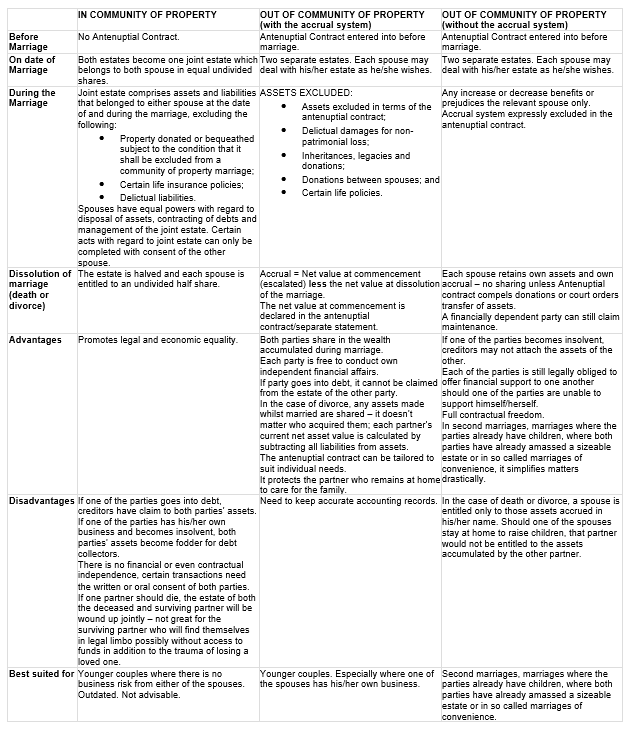
Marriage in community of property and of profit and loss promotes simplicity and equality but consists of joint liabilities. Marriage out of community of property offers options for asset protection and separate estates, without or with sharing growth. When considering which marital regime to make use of, couples should consider their financial compatibility, future plans and pre-marital assets before making an informed decision. The following table provides a clear and simple comparison of all three regimes: